Medical Device Approval in the United Kingdom

Navigate the UKCA marking process with confidence. We guide you from initial classification to market placement, with expert consulting, documentation support, and in-country representation.


UK Regulatory News

QMSR Readiness Assessment: Are you ready for the FDA’s new regulation landing February 2026?
↓

From idea to market success, step by step

Every medical device follows a product life cycle. Here’s how we support you at each stage on your way to MHRA registration in the United Kingdom.

Planning Phase
101Idea
You are at the beginning of your medical device journey in the United Kingdom. We help you understand whether your product falls under UK medical device rules, how to define its intended use, and what the first regulatory decisions mean for UKCA marking, MHRA registration, UK responsible person duties and market access.
202Startup
Your company is taking shape. We help you answer the first regulatory questions, classify your device, identify applicable standards and build a practical route towards UKCA compliance, MHRA registration and international readiness.
Development Phase
606Development
During development we support specification, usability engineering, software validation, risk management, verification and validation, with regulatory planning built into the process.
Software as a Medical DeviceWe help your team build software that meets medical device rules. You learn how to plan, document and test it so it stays compliant.CybersecurityWe help you protect your device against security threats. Strong cybersecurity keeps patients safe and is now expected by regulators everywhere.Usability EngineeringWe help you make your device safe and easy to use. Good usability lowers the risk of mistakes and is a clear requirement for approval.Process ValidationWe help you prove that your production process gives the same result every time. This shows your device can be made reliably and safely at scale.Supplier QualificationWe check and audit your suppliers to make sure they meet your standards. Reliable suppliers protect your quality and keep your supply chain safe.QMS Gap AnalysisWe compare your current quality system with the requirements. You get a clear list of gaps and know exactly what to fix before an audit.Technical Documentation Gap AnalysisWe review your technical file against the requirements. You see what is missing or weak so your documentation is ready when reviewers ask for it.Risk ManagementWe help you find, judge and control the risks of your device. Good risk management runs through your whole project and keeps patients safe.AI Lifecycle ManagementWe help you manage your AI over its whole life, from data to updates. This keeps your software safe and compliant as it learns and changes.Change ManagementWe help you plan and carry out changes to your product or processes the right way. This keeps you compliant whenever you update or improve your device.
Compliance & Submission Phase
Market Phase
1010Sponsor & Representation
1313Market Extension
Expand your reach. We help you enter additional markets, reuse your documentation where possible and adapt your regulatory strategy where needed.

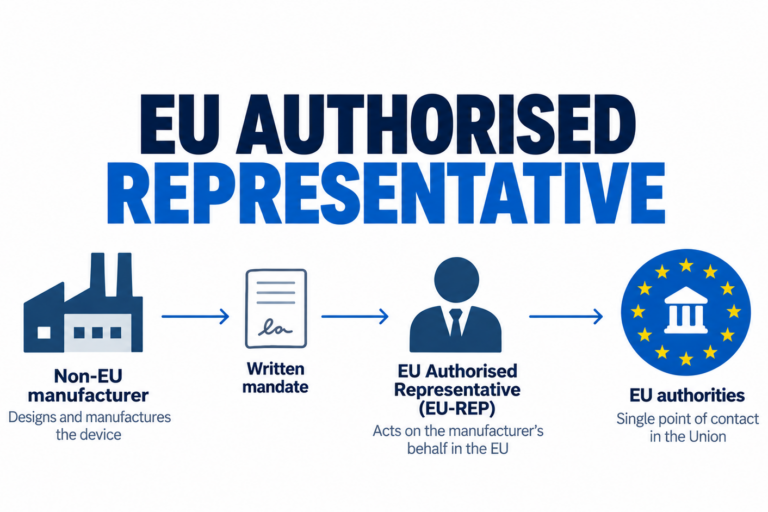
We act as your EU authorised representative

Manufacturers based outside the EU need an authorised representative under the MDR and IVDR before their devices can be placed on the EU market. Elevate Medtech takes on this role, with PRRC support available.

Explore EU Representation →

Ready to enter the UK market?

Book a free consultation and find out how we can support your UKCA marking journey.

EU Authorised Representative

The EU Authorised Representative for medical devices and IVDs

Manufacturers established outside the EU generally need to appoint an EU Authorised Representative before placing medical devices or in vitro diagnostic medical devices on the EU market. Under the MDR and IVDR, the representative has specific regulatory responsibilities and may be jointly and severally liable with the manufacturer for defective devices under the conditions set out in Article 11(5).
Read more